Sewing machine needle size chart: sizes and types by fabric
Last checked: November 27, 2026. This guide is based on research of public sources. We did not test any product.
Short answer
- A larger number means a thicker needle. Schmetz says the metric number is the blade diameter, so size 75 is 0.75 mm.
- Choose the size from the fabric weight and the thread, and the type from the fabric. Schmetz gives this rule on its needle guide.
- For denim, Schmetz makes a Jeans needle, and Brother's chart gives 90/14 to 100/16. For knits, use a ball point (jersey) needle. For leather, use a leather needle, and never on woven or knit fabric.
- Home sewing machines use the 130/705 H needle system, with a flat shank. Put the flat side to the back.
How to read a needle size
Most needle packs show two numbers, such as 80/12. Singer says the first is the European metric size, from 60 to 110, and the second is the American size, from 8 to 18. Source [1] Source [2]
In both systems, a larger number is a thicker needle. Schmetz says the metric number is the blade diameter in hundredths of a millimeter. Brother says thread works the other way: a lower thread number is a thicker thread. Source [3] Source [4]
Makers do not pair the numbers in the same way. Schmetz and Brother write 75/11 and 80/12. Singer's chart writes 11/80 for regular point needles and 12/80 for ball point needles. Compare needles by the metric number. Source [5] Source [6] Source [1] Source [3]
Schmetz says 130/705 H is the needle system of home sewing machines. These needles have a flat shank and a scarf. Brother says to insert the needle with the flat side to the back of the machine. Source [3] Source [4]
Needle types and what each is for
| Needle type | Point and feature | Use it for | Schmetz color code |
|---|---|---|---|
| Universal | Slightly rounded point | Many woven fabrics and knits | Size color only |
| Jersey (ball point) | Medium ball point | Knits and some stretch fabrics | Orange |
| Stretch | Medium ball point, special eye and scarf | Elastic materials and highly elastic knitwear | Yellow |
| Jeans | Medium ball point, reinforced blade | Denim, thick woven fabric, quilts | Blue |
| Microtex (sharp) | Very slim, sharp point | Microfiber, silk, polyester, artificial leather, coated fabric | Purple |
| Quilting | Tapered, slightly rounded point | Piecing and machine quilting | Green |
| Leather | Cutting point | Leather, artificial leather, heavy non-woven synthetics | Brown |
| Topstitch | Elongated eye | Topstitching thread and heavy or multiple threads | Light green |
| Embroidery | Light ball point, wide eye and groove | Rayon and polyester embroidery thread | Red |
| Metallic | Elongated eye | Metallic and other specialty threads | Pink |
Sources for this table: Source [3] Source [7]
Schmetz puts two color bands on the needle. The upper band shows the type and the lower band shows the size. Source [3]
Singer uses style numbers. Style 2020 is the universal needle for woven fabric, and 2045 is the ball point for knits. Style 2026 is for denim and canvas, and 2032 is for leather and vinyl. Source [1] Source [2]
Needle size chart by fabric
| Fabric | Needle type | Sizes |
|---|---|---|
| Chiffon, organza | Universal or Microtex | 60/8, 70/10 |
| Silk | Microtex | 60/8 to 90/14 |
| Woven cotton | Universal | 70/10 to 90/14 |
| Linen | Universal | 70/10 to 90/14 |
| Flannel | Universal | 80/12 to 110/18 |
| Denim | Jeans | 70/10 to 110/18 |
| Canvas | Jeans | 90/14 to 110/18 |
| Jersey | Jersey | 60/8 to 80/12 |
| Knit cotton | Jersey or Stretch | Jersey 70/10 to 90/14; Stretch 75/11, 90/14 |
| Lycra | Stretch or Jersey | Stretch 65/9 to 90/14; Jersey 70/10 to 90/14 |
| Fleece | Universal or Stretch | Universal 70/10 to 90/14; Stretch 75/11, 90/14 |
| Sweatshirt | Jersey | 70/10 to 90/14 |
| Thin leather | Leather or Universal | 70/10 to 90/14 |
| Thick leather and artificial leather | Leather | 100/16 to 120/19 |
| Vinyl | Microtex | 60/8 to 90/14 |
| Quilt | Quilting or Jeans | Quilting 75/11, 90/14; Jeans 70/10 to 110/18 |
Sources for this table: Source [5]
Schmetz says this is not a complete list and that more than one needle type often suits a fabric. Its ranges are wide, so use a size at the low end for light fabric and the high end for heavy fabric. Source [5] Source [6]
| Fabric | Brother | Singer |
|---|---|---|
| Thin or sheer woven | 65/9 to 75/11 | Regular point 9/70 or 11/80 |
| Medium weight woven | 75/11 to 90/14 | Regular point 14/90 |
| Denim and other thick fabric | 90/14 to 100/16 | Denim 16/100 |
| Light stretch knits (jersey, tricot) | Ball point 75/11 to 90/14 | Ball point 10/70 or 12/80 |
| Leather, suede | Not in the chart | Wedge point 14/90 or 16/100 |
Sources for this table: Source [4] Source [6] Source [1]
Denim, leather, and knits
Denim: Schmetz says its Jeans needle goes through thick woven fabric with less deflection and less risk of needle breaks. Brother warns that a 65/9 to 75/11 needle in denim can bend or break. Source [3] Source [4]
Makers do not agree on the jeans needle point. Schmetz describes a medium ball point. Janome describes a sharp point. Both describe a strong shaft or blade for thick fabric. Source [3] Source [8]
For denim, Singer suggests its Denim style 2026 needle and a stitch length of 4 to 5. For topstitching, it says to put topstitching thread on top and regular thread in the bobbin. Source [9]
Leather: Schmetz and Janome both say a leather needle has a cutting or wedge point. Both say never to use it on woven or knit fabric. For artificial leather, Schmetz also lists the Microtex needle, 70/10 to 100/16. Source [3] Source [8] Source [5]
Knits: Schmetz says the medium ball point of its Jersey needle does not damage or break knit fibers. Use a Stretch needle for fabric with a lot of elastic. Brother's chart gives a gold ball point needle for jersey and tricot. Source [3] Source [6]
Singer says a regular point needle on stretch knit can skip stitches. Our skipped stitches guide has the other causes. Source [1]
Match the needle to the thread
- Choose the needle size for the thread thickness. Schmetz gives this rule in its needle guide. Source [3]
- If the thread shreds, Singer says the needle may be too small for the thread. Use a larger needle or a finer thread. Source [1]
- Brother says never to use thread of weight 20 or lower in its home machines, because it can cause a malfunction. Source [4] Source [6]
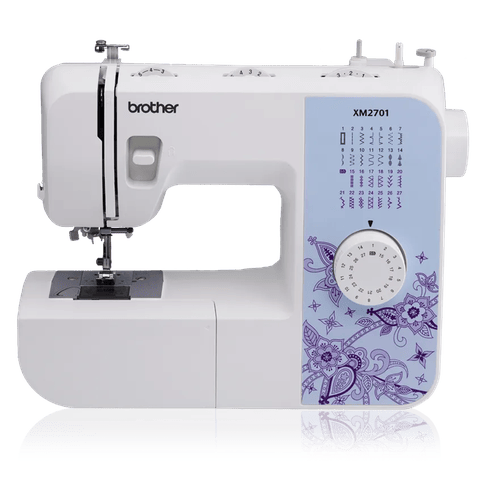
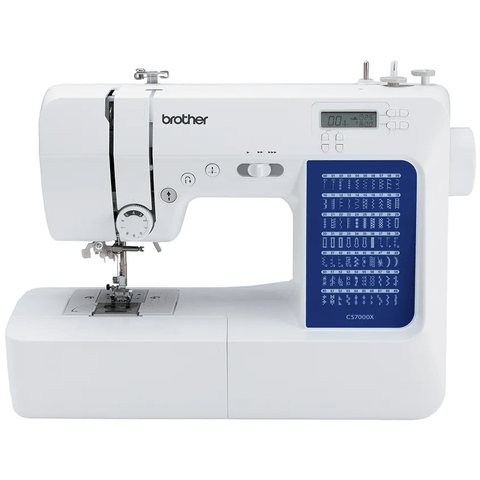
- For transparent nylon thread, the XM2701 manual says to use a 90/14 to 100/16 needle, whatever the fabric. The CS7000X manual says to use a topstitching needle. Source [4] Source [6] Source [10]
- For heavy topstitching thread, Schmetz and Janome make a topstitch needle with a larger eye. Source [3] Source [8]
WeAllSew, the BERNINA blog, gives a quick test. Thread the needle, hold the thread at about 45 degrees, and let the needle hang. If it does not slide, the needle may be too small for the thread. Source [11]
When to change the needle
- Schmetz: about every 8 hours of sewing. Schmetz says a worn needle can cause broken threads, skipped stitches, puckered fabric, and a popping sound. Source [12] Source [3]
- Singer: about every 6 to 8 hours on its FAQ page, and 8 to 10 hours on its help center. The help center also says after 2 or 3 garments, or after you hit a pin. Source [9] Source [1]
- Brother: generally after one project, such as a piece of clothing. Also when the needle makes an unusual sound or stitches skip. Source [10]
- Janome Australia gives an average life of 8 hours and says to start each project with a new needle. Source [13]
To check a needle, Brother says to put its flat side on a flat surface, such as glass. The gap between the needle and the surface must be even. Do not use a bent needle. Source [4] Source [10]
Questions people ask
- What size needle should I use for denim?
Brother's chart gives 90/14 to 100/16 for denim, and Singer gives a 16/100 denim needle. Schmetz lists its Jeans needle from 70/10 to 110/18 for denim, so pick the size by the fabric weight. Source [4] Source [1] Source [5]
- What needle should I use for leather?
Use a leather needle, which has a cutting point. Schmetz gives 70/10 to 90/14 for thin leather and 100/16 to 120/19 for thick leather. Schmetz and Janome say never to use it on woven or knit fabric. Source [3] Source [5] Source [8]
- What needle should I use for knit or stretch fabric?
Use a ball point (jersey) needle. Brother gives 75/11 to 90/14 for jersey and tricot. For highly elastic fabric, Schmetz makes a Stretch needle with a special eye and scarf. Source [6] Source [3]
- What do the two numbers on a sewing machine needle mean?
The first is usually the metric size and the second the American size, as in 80/12. Schmetz says the metric number is the blade diameter, so size 75 is 0.75 mm. A larger number is a thicker needle. Source [3] Source [1]
- What does 130/705 H mean on a needle pack?
Schmetz says 130/705 H is the needle system for home sewing machines. The needles have a flat shank and a scarf. The flat side goes to the back of the machine. Source [3] Source [4]