Sewing machine skipping stitches: causes and fixes
Last checked: November 27, 2026. This guide is based on research of public sources. We did not test any product.
Short answer
- Start with the needle. Brother, Singer, and Schmetz all list a bent, dull, or damaged needle as a cause of skipped stitches. Put in a new one.
- Make sure that the needle is pushed all the way up with the flat side to the back. Then rethread the upper thread and the bobbin.
- On knits and stretch fabric, use a ball point or stretch needle. Singer says a regular point needle on stretch knit can skip stitches.
- If the skipping continues after these checks, the timing may be off. Singer and Schmetz say a service center must adjust it.
Why a stitch skips
A stitch forms when the hook below the needle plate catches a loop of the upper thread. WeAllSew, the BERNINA blog, says a stitch skips when no correct loop forms behind the needle for the hook to catch. Source [1]
Janome says the scarf, a short cut above the needle eye, lets the hook get close enough to catch the loop. A longer and deeper scarf gives the hook more time, which helps to prevent skipped stitches. Source [2]
WeAllSew says about 80 percent of these problems do not come from the machine. Its list starts with the threading and the needle, and puts hook timing last. Source [1]
The checks, in order
Makers do not give one exact order. Brother's XM2701 support page starts with the needle. WeAllSew starts with the threading. All of them put the needle and the threading before the timing. Source [3] Source [1] Source [4]
- Replace the needle. Brother names a needle that is bent, turned, or dull. The CS7000X manual says skipped stitches are a sign that the needle may be bent. Source [3] Source [5] Source [4]
- Install the needle correctly. Singer says to push it all the way up into the clamp with the flat side to the back. WeAllSew says a needle that is not fully up skips more at the far left and right needle positions. Source [6] Source [7] Source [1]
- Rethread the upper thread and the bobbin. Brother lists a bobbin installed incorrectly and incorrect upper threading after the needle. Source [3] Source [1]
- Use a needle that suits the fabric. Brother says the wrong needle or thread for the fabric can cause wrinkled fabric or skipped stitches. Source [8] Source [7]
- Use a needle that suits the thread. WeAllSew says a large needle with a fine thread can make a loop too small for the hook to catch. Source [1]
- Clean out the lint. The XM2701 manual lists dust under the needle plate or in the bobbin case. It says to remove the needle plate and clean both. Source [7] Source [9]
- Check the tension. Schmetz lists thread tension that is set too high as a cause, and says to reset the top and bobbin tension. Source [10]
- Have the timing checked. Singer says skipping that continues after the needle checks is likely a timing problem for a service center. Schmetz names the timing, the hook to needle clearance, and the needle bar height. Source [4] Source [10] Source [1]
WeAllSew gives a test for the needle and the thread. Thread the needle, hold the thread at about 45 degrees, and let the needle hang. The needle should slide down the thread under its own weight. Source [1]
Knits, stretch fabric, and thin fabric
Singer says skipped stitches on stretch fabric usually come from a regular point needle. Its fix is a ball point needle, Singer style 2045. Brother says to use a ball point needle where skipped stitches easily occur. Source [11] Source [7]
Brother's chart gives a gold ball point needle, size 75/11 to 90/14, for jersey and tricot. The XM2701 manual names the Schmetz Jersey Ball Point 90/14 as a substitute for its factory needle. Source [7] Source [12]
For fabric with a lot of stretch, Schmetz makes a Stretch needle. Schmetz says its medium ball point, eye, and scarf prevent skipped stitches in elastic materials and highly elastic knitwear. Source [13]
Thin or elastic fabric can move up and down with the needle. WeAllSew calls this flagging. Its fixes are a smaller needle, a straight stitch plate and foot, wash-away stabilizer, and more presser foot pressure. Source [1]
Thick fabric, denim, and seams
Brother warns that a thin needle in heavy fabric, such as denim with a 65/9 to 75/11 needle, can skip stitches or bend the needle. Its chart gives 90/14 to 100/16 for denim. Source [7] Source [5]
Singer suggests a size 16 or 18 needle for heavy fabric, with a stitch length of 3 to 4. Sew at a moderate speed over thick seams. For denim, it names its Denim style 2026 needle. Source [4]
Schmetz says its Jeans needle goes through thick woven fabric with less deflection, and with less risk of needle breaks and skipped stitches. Our needle size chart lists the sizes by fabric. Source [13]
Brother's XM2701 and ST371HD manuals warn against fabric more than 6 mm (15/64 inch) thick. They say the needle can bend or break. Source [7] Source [14]
Symptom, likely cause, and fix
| Symptom | Likely cause | Fix |
|---|---|---|
| Skips on any fabric, started suddenly | A bent, dull, or damaged needle | Put in a new needle. Push it all the way up with the flat side to the back. |
| Skips on knits or stretch fabric | A regular point needle on a knit | Use a ball point needle, or a stretch needle for elastic fabric. |
| Skips on denim or thick layers | A needle that is too small for the fabric | Use a jeans needle or a larger size. Sew slowly over thick seams. |
| Skips on thin fabric | The fabric moves up and down with the needle (flagging) | Use a smaller needle, a straight stitch plate, and more presser foot pressure. |
| Skips after a new needle and rethreading | Lint below the needle plate, or tension set too high | Clean the bobbin area. Reset the top and bobbin tension. |
| Skips that continue after all the checks | The machine is out of timing | Take the machine to a service center. |
Sources for this table: Source [3] Source [7] Source [4] Source [11] Source [10] Source [1]
Skipped stitches recorded in our machine guides
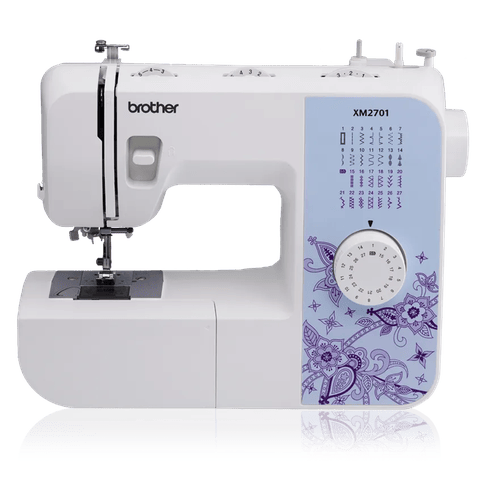
- Brother XM2701: Brother's support page names a bent, turned, or dull needle, a bobbin installed incorrectly, and incorrect upper threading. The manual adds dust under the needle plate. Source [3] Source [7]
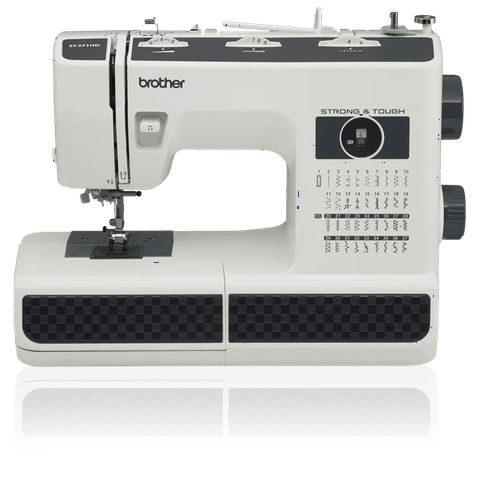
- Brother ST371HD: the manual says to use a ball point needle on fabric where skipped stitches easily occur. It warns against fabric more than 6 mm thick. Source [14]
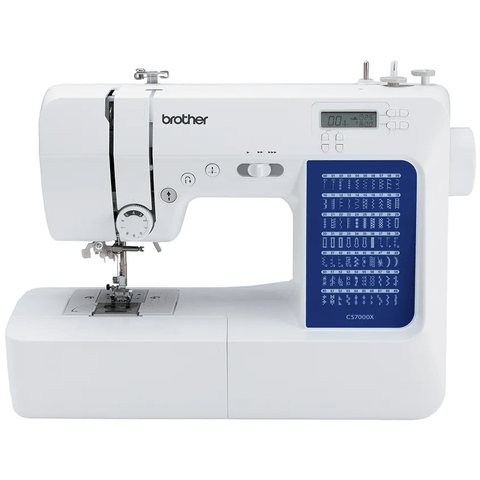
- Brother CS7000X: the manual says to replace the needle when stitches skip, because the needle may be bent. Source [5]
- Singer Heavy Duty 4423 and Singer Heavy Duty 4452: Singer's general FAQ says to turn the handwheel toward you only. It says turning it the other way can disturb the timing and cause a service visit. Source [4]
If thread also tangles below the fabric, see our guide to a sewing machine that keeps jamming. Source [15]
Questions people ask
- Why is my sewing machine skipping stitches?
Brother lists a bent, turned, or dull needle first, then a bobbin installed incorrectly and incorrect upper threading. Put in a new needle and rethread the machine before the other checks. Source [3]
- Why does my sewing machine skip stitches on stretch fabric?
Singer says the usual cause is a regular point needle. Use a ball point needle on knits. Schmetz makes a Stretch needle for highly elastic fabric, with a scarf that prevents skipped stitches. Source [11] Source [13]
- Why does my machine skip stitches on denim or thick seams?
Brother says a needle that is too thin for heavy fabric can skip stitches. Use a 90/14 to 100/16 needle for denim. Singer also says to sew at a moderate speed over thick seams. Source [7] Source [4]
- How often should I change my sewing machine needle?
Schmetz says about every 8 hours of sewing. Singer gives 6 to 8 hours on one page and 8 to 10 hours on another. Brother says after one project, such as a piece of clothing. Source [10] Source [4] Source [11] Source [5]
- Can bad timing make a sewing machine skip stitches?
Yes. Singer says skipping that continues after the needle checks is likely a timing problem, and a service center must fix it. WeAllSew calls timing the least likely cause. Source [4] Source [1]