Sewing machine vs serger: what each does and which to buy first
Last checked: November 27, 2026. This guide is based on research of public sources. We did not test any product.
Short answer
- Buy a sewing machine first. The University of Kentucky Extension and the Home Sewing Association both say a serger does not replace a sewing machine.
- A serger sews the seam, trims the edge with a knife, and wraps the edge in thread, all in one pass. It uses loopers and several threads instead of a bobbin.
- A serger cannot make buttonholes, put in zippers, sew in reverse, or topstitch unless it can coverstitch. A sewing machine does those jobs.
- Add a serger when you sew many knits or want seams that look like ready-to-wear. Many serger stitches stretch, and differential feed controls puckers and ripples.
The two machines side by side
| Point | Sewing machine | Serger |
|---|---|---|
| How it forms the stitch | A needle thread and a bobbin thread | Looped stitches from 1 or 2 needles and 1 to 3 loopers, with no bobbin |
| Number of threads | 2 | Usually 3, 4, or 5; some top models use up to 10 |
| Trims the fabric edge | No | Yes, with a knife that you can disengage on many models |
| Speed | About 600 stitches per minute (Kentucky); 300 to 800 (Brother) | Up to 1,700 stitches per minute (Kentucky); 1,300 on the Brother 1034DX |
| Buttonholes, zippers, reverse, topstitching | Yes | No, except topstitching on models that can coverstitch |
| Seams on knits | Stretch stitches and overcast stitches | Many serger stitches have built-in stretch |
Sources for this table: Source [1] Source [2] Source [3] Source [4] Source [5]
The sources do not agree on speeds. The Kentucky guide says a sewing machine sews about 600 stitches per minute. The Brother 1034DX manual gives 300 to 800 for an ordinary sewing machine. Source [1] Source [4]
What a serger does well
The University of Kentucky guide says a serger stitches a seam, trims it, and overcasts the edge in one operation. The result looks like the seams in ready-to-wear clothing. Source [1]
- Finishes seams and raw edges so they do not fray. This is the main job, says the Home Sewing Association. Source [2]
- Sews stretch seams. The Home Sewing Association says many serger stitches have built-in stretch, so they suit knit fabrics. Source [2]
- Sews rolled hems. On the Brother 1034DX you remove the left needle and use the 3-thread stitch for a narrow rolled edge. Source [4] Source [2]
- Controls puckers and ripples with differential feed. Brother says a ratio above 1 gathers the fabric to stop rippling on stretch fabrics. A ratio below 1 stretches lightweight fabric to stop puckers. Source [4] Source [1]
- Carries thick decorative thread. The Home Sewing Association says looper eyes are larger than needle eyes. Source [2]
- Applies elastic and trims, and gathers fabric. Source [2]
Brother says the 1034DX four-thread stitch makes a strong seam on knits and wovens. Its three-thread stitch uses one needle, for a 5 mm seam with the left needle or a 2.8 mm seam with the right. Source [4]
What a serger cannot do
The Home Sewing Association lists what sergers do not do. They do not baste, sew in reverse, install zippers, make buttonholes, or embroider. They topstitch only if they can coverstitch. The Kentucky guide adds standard seams that you press open. Source [2] Source [1]
The knife trims as you sew, so a serged seam leaves very little seam allowance. Sewing Machines Plus says this makes a serger a poor tool for fitting, where you sew, try on, and sew again. Source [5]
A serger alone also has limits on wovens. The Kentucky guide says to reinforce 3-thread seams on loosely woven fabrics or in areas of stress with a sewing machine. Madam Sew says you cannot make a woven cotton blouse with a serger alone. Source [1] Source [6]
Hems with two parallel rows of stitches on top come from a coverstitch. The Kentucky guide says some top sergers convert to coverstitch, and stand-alone coverstitch machines also exist. Sewing Machines Plus says a coverstitch machine has one looper and no knives. Source [1] Source [7]
Can a sewing machine do the serger's job?
Partly. The Home Sewing Association says most sewing machines have an overlock or overcast stitch. But a sewing machine cannot cut the fabric as it stitches, cannot use the thicker decorative threads, and is much slower. Source [2]
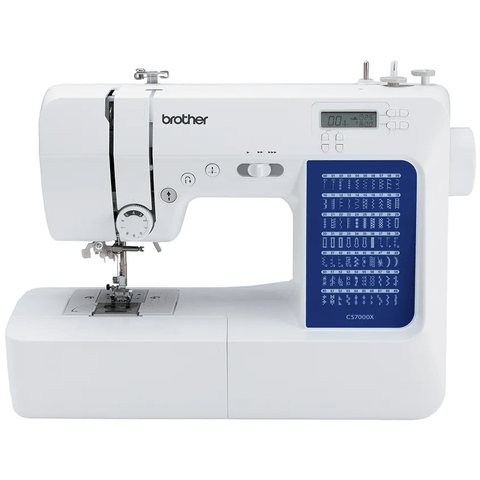
Brother's CS7000X manual describes overcasting stitches with foot G along cut edges to stop fraying. For knits, the Home Sewing Association says to look for stretch stitches or overcast stitches with built-in flexibility. Source [8] Source [3]
Madam Sew says you can sew knits on a regular machine, but it takes more time and care. Source [6]
Which to buy first
A sewing machine. The Home Sewing Association asks whether you need a serger and answers probably not. Madam Sew calls a sewing machine essential when you are just starting. Our guide to choosing a first sewing machine covers that purchase. Source [2] Source [6]
Sewing Machines Plus says to add a serger when knit seams or repeated seam finishing slow you down. Its test is to track your projects for a month and count how often you need knit seams and rolled hems. Source [5]
- Will you use it for more than edge finishes? This is the first question on the Home Sewing Association list. Source [2]
- Will you seam knits, wovens, or both? The Kentucky guide says a 3-thread machine works most effectively on stretch fabrics. Source [2] Source [1]
- Will you try decorative threads or the flatlock stitch? Source [2]
- Will you sew large items, such as curtains, that need clean seams? Source [2]
If you shop for a serger
- Threading: the Home Sewing Association says to thread and rethread any serger before you buy it. The lower looper is usually the hardest path. Brother prints color-coded guides on the 1034DX. Source [2] Source [9]
- Threads: the Kentucky guide calls the 3/4-thread serger the most versatile basic machine, because it sews as a 3-thread or a 4-thread machine. The Brother 1034DX works with 3 or 4 threads. Source [1] Source [9]
- Differential feed: the Kentucky guide calls it essential for stretchy fabrics. Source [1]
- Knife: check how to stop the blades from trimming. On the 1034DX you retract the knife with a lever. Source [1] Source [4]
- Needles: the Kentucky guide says some sergers use regular sewing machine needles and others need industrial needles. Brother says the 1034DX uses standard home sewing machine needles, 130/705H in size 80 or 90. Source [1] Source [4]
- Dealer, lessons, and service: the Kentucky guide and the Home Sewing Association both say to try machines at a dealer. Ask about classes and repairs. Source [1] Source [2]
Questions people ask
- Can a serger replace a sewing machine?
No. The University of Kentucky Extension says you still need a sewing machine for zippers, buttonholes, topstitching, and standard seams that you press open. The Home Sewing Association says the same. Source [1] Source [2]
- Is a serger the same as an overlocker?
Yes. Sewing Machines Plus says the two names mean the same machine. Most Americans say serger, and most other countries say overlocker. Brother calls its 1034DX an overlock machine. Source [7] Source [4]
- Do I need a serger to sew knits?
No. The Home Sewing Association says to look for stretch or overcast stitches on a sewing machine for knits. Madam Sew says knits on a regular machine take more time and care. A serger makes knit seams faster. Source [3] Source [6] Source [2]
- Can a serger hem?
It sews narrow rolled hems. The Brother 1034DX does this with the left needle removed. A coverstitch hem needs a serger that converts to coverstitch, or a separate coverstitch machine, says the University of Kentucky Extension. Source [4] Source [1]
- Does a serger use regular sewing machine needles?
Some do. The University of Kentucky Extension says some sergers take regular sewing machine needles and others need industrial needles. Brother says the 1034DX takes standard 130/705H home sewing machine needles. Source [1] Source [4]